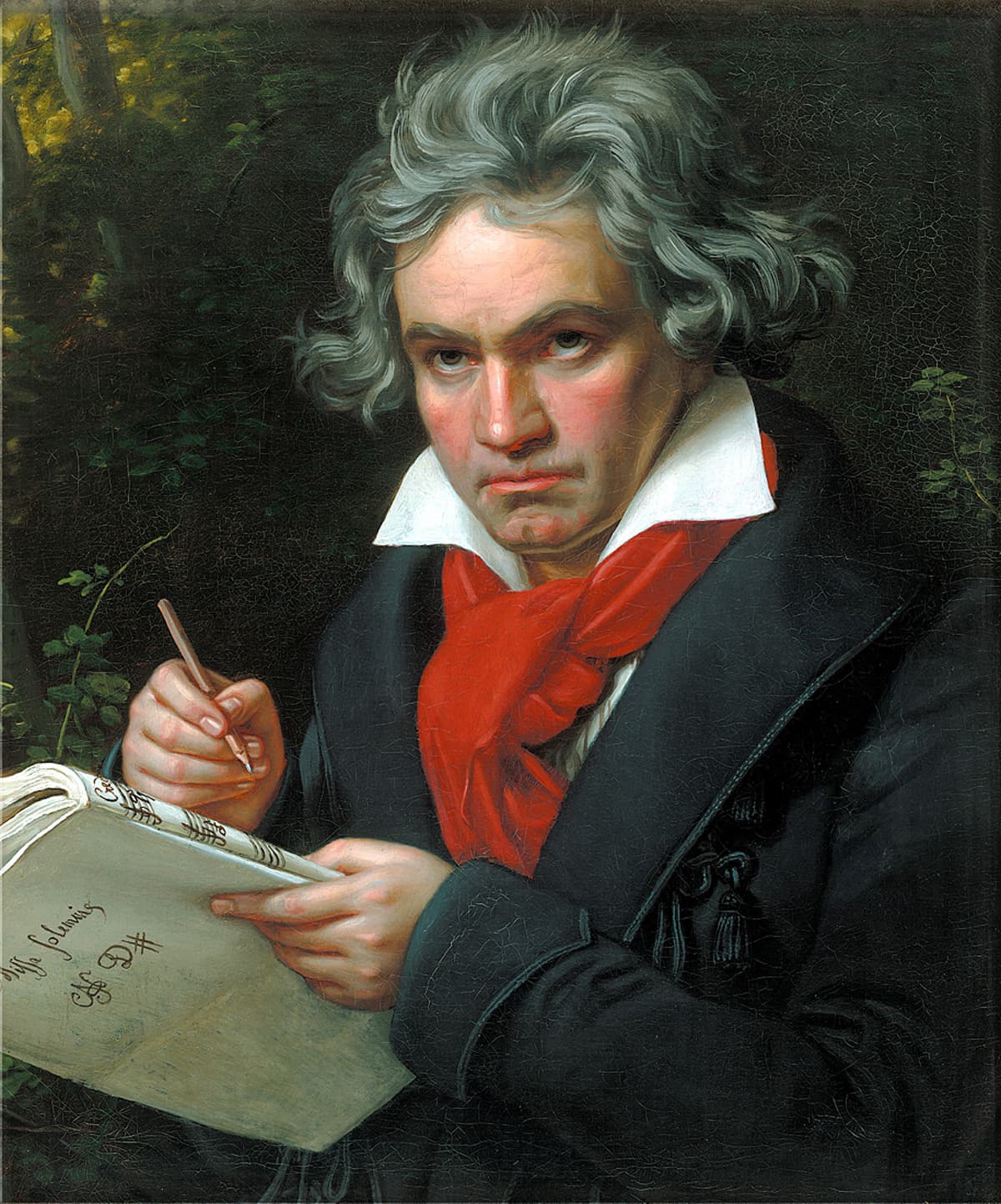
Ludwig van Beethoven
Early Life and Bonn Years
Beethoven was born in Bonn into a musical dynasty: his grandfather Ludwig van Beethoven had been the Electoral court Kapellmeister, and his father Johann, a court singer with outsized ambitions, subjected the boy to an intense and sometimes brutal musical regime.
The most formative influence of his youth was the organist and composer Christian Gottlob Neefe, who introduced him to Bach's Well-Tempered Clavier, supervised the publication of his earliest compositions, and publicly proclaimed his genius in a music journal as early as 1783.
By his mid-teens Beethoven was deputy court organist and had secured the admiring patronage of Count Ferdinand von Waldstein, a young Austrian nobleman who would champion him for decades. A brief visit to Vienna in 1787 was cut short by the fatal illness of his mother, after which Beethoven became the effective head of his household, supporting his two younger brothers while his father's alcoholism worsened.
When Haydn passed through Bonn in 1792 and agreed to take him as a pupil, Waldstein famously urged Beethoven to go to Vienna and receive 'Mozart's spirit from Haydn's hands.' He left Bonn that November, never to return.
Chronology
- Baptism in Bonn
- First Public Performance
- Studied violin with Franz Ries
- Studies with Christian Gottlob Neefe
- First Published Composition
- Appointed continuo player in orchestra
- Assistant Court Organist Appointment
- Mentored by Count Waldstein
- First Visit to Vienna
- First Documented Concert Appearance
- Move to Vienna
- Father's Death
- Joined Count Waldstein's Musical Circle
Vienna Arrival and Early Career
Beethoven conquered Vienna with extraordinary speed. His reputation as a pianist preceded him through aristocratic salons, and his public debut at the Burgtheater in 1795 — most likely performing an early version of his Second Piano Concerto — confirmed him as the city's most electrifying keyboard talent, celebrated above all for an improvisational power that struck contemporaries as almost supernatural.
He moved into the palace of his principal patron Prince Karl von Lichnowsky, to whom his first major published works, the Piano Trios Op. 1, were dedicated. A triumphant concert tour in 1796 took him to Prague, Dresden, and Berlin, where he played for King Frederick William II of Prussia and reportedly declined a permanent court appointment.
By 1798, composing the dramatically charged Pathétique Sonata and the early Violin Sonatas Op. 24, he was already moving decisively beyond his Viennese predecessors — while privately confronting the first, terrifying signs of hearing loss that he concealed from virtually everyone around him.
Chronology
- Vienna Public Debut
- First Published Works
- First Concert Tour
- Vienna Debut as Piano Soloist
- Collaboration With Violinist Ignaz Schuppanzigh Begins
- Composes Pathétique Sonata
- Begins to Lose Hearing
Rising Composer and Early Masterpieces
These years mark the moment Beethoven consciously broke with the inheritance of Haydn and Mozart and forged an entirely personal language. His First Symphony (1800), though still rooted in the Classical tradition, unsettled audiences with its provocative opening harmony; by 1802 his worsening deafness had brought him to the edge of suicide, a despair recorded with wrenching candour in the private Heiligenstadt Testament, a letter to his brothers never sent.
That crisis proved a turning point: what followed was an eruption of revolutionary masterworks spanning every major form. The Eroica Symphony — originally conceived as a homage to Napoleon Bonaparte and famously re-dedicated after Napoleon's imperial coronation — nearly doubled the scale and emotional scope of any previous symphony. The Waldstein and Appassionata sonatas redefined the expressive possibilities of the piano, and the three Rasumovsky Quartets Op. 59 — commissioned by the Russian ambassador Count Razumovsky — initially baffled audiences and performers alike with their unprecedented length and daring.
His only opera, Fidelio, premiered in 1805 during the French occupation of Vienna; Beethoven revised it twice before reaching the definitive version in 1814, imbuing its story of political imprisonment and liberation with unmistakable ideological force.
Chronology
- First Symphony Premiere
- Publishes 'Moonlight' Sonata
- Piano Sonata No. 17 'The Tempest'
- Heiligenstadt Testament
- Eroica Symphony Begun
- Appointed Kapellmeister at Theater an der Wien
- Landmark Theater an der Wien Concert
- Fidelio Premiere
- Rasumovsky Quartets Composed
- Mass in C major composed
- Coriolan Overture completed
- King Stephen and The Ruins of Athens Overtures
- Collaboration With the Theater an der Wien Orchestra
Heroic and Middle Period
On 22 December 1808, a single four-hour concert at the Theater an der Wien — badly under-rehearsed, held in an unheated hall — brought into the world the Fifth Symphony with its iconic four-note opening motif, the Sixth 'Pastoral' Symphony, the Fourth Piano Concerto, and the Choral Fantasy.
The following year, when Napoleon's brother Jerome offered Beethoven a court Kapellmeistership, three Viennese patrons — Archduke Rudolf, Prince Lobkowitz, and Prince Kinsky — jointly guaranteed him an unprecedented life annuity to keep him in Vienna as a free artist. The period saw the completion of the majestic Emperor Concerto and the Archduke Trio, the latter also Beethoven's last public performance as a pianist, his deteriorating hearing making the occasion distressing for all present.
The Immortal Beloved letter of 1812 — a passionate, unsent declaration to an unnamed woman — has fascinated biographers ever since, its recipient still debated.
These years closed on a darker note: the death of his brother Caspar Carl in 1815 from tuberculosis triggered an obsessive and exhausting legal battle with his sister-in-law Johanna for sole custody of his nephew Karl, a conflict that would consume much of his energy for five years.
Chronology
- Premiere of 5th and 6th Symphonies
- Appointed to Life Pension
- Piano Concerto No. 5 'Emperor'
- Last Public Performance as Pianist
- Composes 'Für Elise'
- Letter to the 'Immortal Beloved'
- Premiere of Wellington's Victory
- Egmont Overture premiered
- Archduke Trio premiered
- Cello Sonatas Op. 102 composed
- Death of Brother Caspar
Late Works and Final Years
Completely deaf by around 1818 and able to converse with visitors only through written conversation books, Beethoven entered the most inward and visionary phase of his creative life — paradoxically producing works of greater ambition and originality than anything he had written before. The Hammerklavier Sonata Op. 106 was so technically extreme that it remained nearly unplayable for decades; the Diabelli Variations transformed a trivial waltz theme into a philosophical summit of keyboard writing, often ranked alongside Bach's Goldberg Variations.
The Missa Solemnis, begun to honour the ordination of his patron Archduke Rudolf as Archbishop of Olmütz, grew so vast and took so long that the ceremony passed years before its completion; Beethoven considered it his greatest work.
On 7 May 1824, the premiere of the Ninth Symphony — composed entirely in silence, its choral finale setting Schiller's Ode to Joy — became one of the most celebrated events in music history; Beethoven stood at the podium directing tempos but heard nothing, and had to be turned to face the audience to realise the ovation that had erupted behind him.
His final five string quartets, particularly Op. 131 in C-sharp minor and Op. 132 with its transcendent 'Heiliger Dankgesang,' baffled contemporary audiences and remained decades ahead of their time. Beethoven died in Vienna on 26 March 1827, after months of illness; Franz Schubert was among the torchbearers at a funeral attended by an estimated 10,000 to 20,000 people.
Chronology
- Severe Deafness Confirmed
- Diabelli Variations composed
- Collaboration With Anton Diabelli
- Ninth Symphony Begun
- Completion of Missa Solemnis
- Piano Sonata No. 29 'Hammerklavier'
- Piano Sonata No. 32 composed
- Ninth Symphony Premiere
- Late String Quartets Composed
- Quartet in C-sharp Minor Completed
- Beethoven's Death
- Beethoven's Funeral